

MDACI CSRD POLICY STATEMENT
I. GENERAL CRSD POLICY FRANMEWORK
1. Introduction
MDA CAPITAL INVEST, a.s. (MDACI) establishes this policy to ensure full alignment with the EU Corporate Sustainability Reporting Directive (CSRD) (Regulation (EU) 2022/2464). As a financial sponsor, project developer, and facilitator of large-scale engineering, procurement, construction, installation, and maintenance (EPCIM) projects, MDACI applies these mandatory standards across our operations, investment value chains, and bankable project entities
2. Dual-Materiality Framework (ESRS 1/ESRS 2)
We evaluate and report our sustainability impacts using the mandatory double-materiality lens, analyzing both our internal operations and external asset portfolios.
-
-
- Impact materiality. Identify and quantify how our industrial projects, manufacturers, and EPCIM contractors affect people and the planet.
- Financial materiality. Measure how external ESG risks, climate disruptions, and regulatory shifts financially impact MDACI assets, investments, and project bankability.
- Stakeholder engagement. Conduct structured dialogues with industrial buyers, distributors, financiers (commercial/investment banks), and ECAs to continuously update our materiality matrix.
-
3. Environmental Targets and Decarbonisation (ESRS E1/E5)
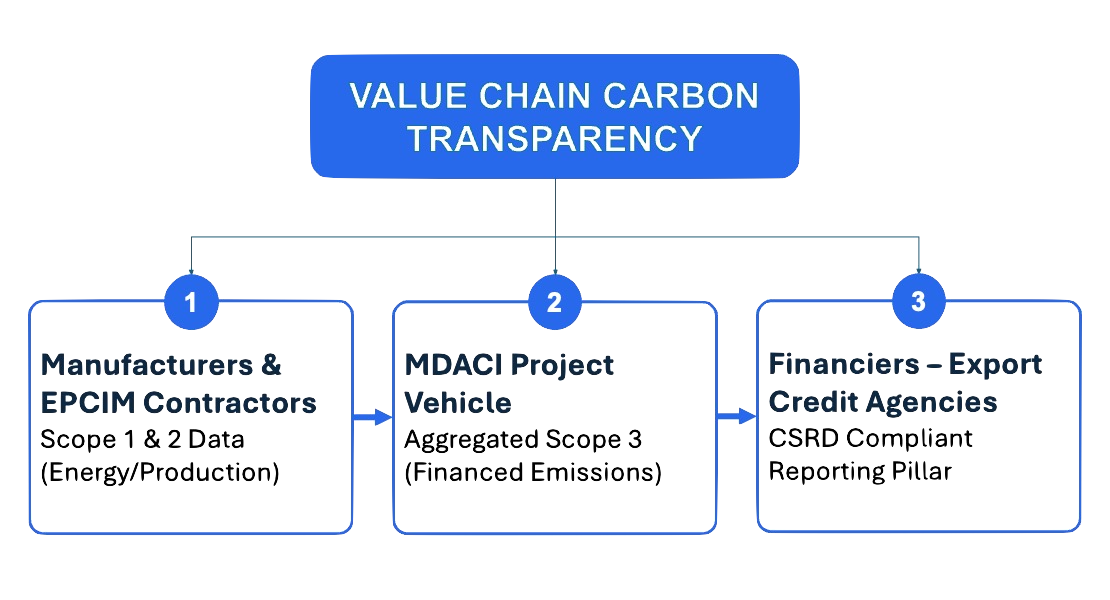
We mandate rigorous data collection from our industrial value chain to satisfy European Green Deal objectives and EU Taxonomy requirements.
-
-
- Climate Change (E1). Disclose full Scope 1, Scope 2, and Material Scope 3 greenhouse gas (GHG) emissions, including the financed emissions of our investment portfolios.
- Transition Planning. Maintain a corporate transition plan aligned with the Paris Agreement goal to limit global warming to 1.5°C and achieve net-zero by 2050.
- Circular Economy (E5). Require industrial product manufacturers and EPCIM contractors to provide resource inflow/outflow metrics, prioritizing scrap recycling and waste-heat recovery.
- Water & Biodiversity (E2/E4). Enforce Environmental and Social Impact Assessments (ESIAs) for all infrastructure assets to protect local ecosystems and water resources.
-
4. Social and labour standards (ESRS S1 – S4)
We protect human capital and ensure fair labour practices across all corporate sites, project locations, and supplier factories.
-
-
- Own Workforce (S1). Disclose metrics on gender pay equality, diversity, occupational health and safety, and continuous professional development tracks.
- Value Chain Workers (S2). Audit EPCIM contractors and industrial product distributors to eliminate forced labour, child labour, and human rights violations.
- Affected Communities (S3). Implement mandatory local grievance mechanisms at project construction sites to address community concerns promptly.
- Consumers & End-Users (S4). Ensure industrial buyers receive transparent safety data sheets and product lifecycle environmental footprint metrics.
-
5. Governance, business conduct and anti-crime (ESRS G1)
We operate under strict ethical guardrails to guarantee compliance, corporate transparency, and investor trust.
-
-
- Anti-Corruption Frameworks. Enforce strict anti-bribery, anti-corruption (ABC), and anti-money laundering (AML) screening across all special purpose vehicles (SPVs).
- Supplier Code of Conduct. Bind all manufacturers, distributors, and contractors to a mandatory ethical charter matching ESRS G1 guidelines.
- Whistleblowing Infrastructure. Provide secure, independent reporting hotlines for internal staff, contractors, and external project stakeholders.
-
6. CSRD reporting architecture and digital tagging
We format our sustainability data to ensure it seamlessly integrates into the digital financial ecosystem for our banking and institutional partners.
-
-
- Management report integration. Publish CSRD disclosures directly within a dedicated section of the MDACI Annual Management Report.
- ESEF XHTML formatting. Prepare disclosures in the digital XHTML format, utilizing Inline XBRL (iXBRL) tags for machine-readable financial analysis.
- Third-party assurance. Subject all sustainability metrics to mandatory independent, limited assurance auditing before public release.
- Financier data feeds. Standardize ESG exports to directly satisfy the regulatory compliance mandates of Export Credit Banks, ECAs, and commercial lenders.
-
I. SUSTAINABILITY AND ESG VALUE PROPOSITION (CSRD ALIGNED)
1. Strategic ESG Advantage
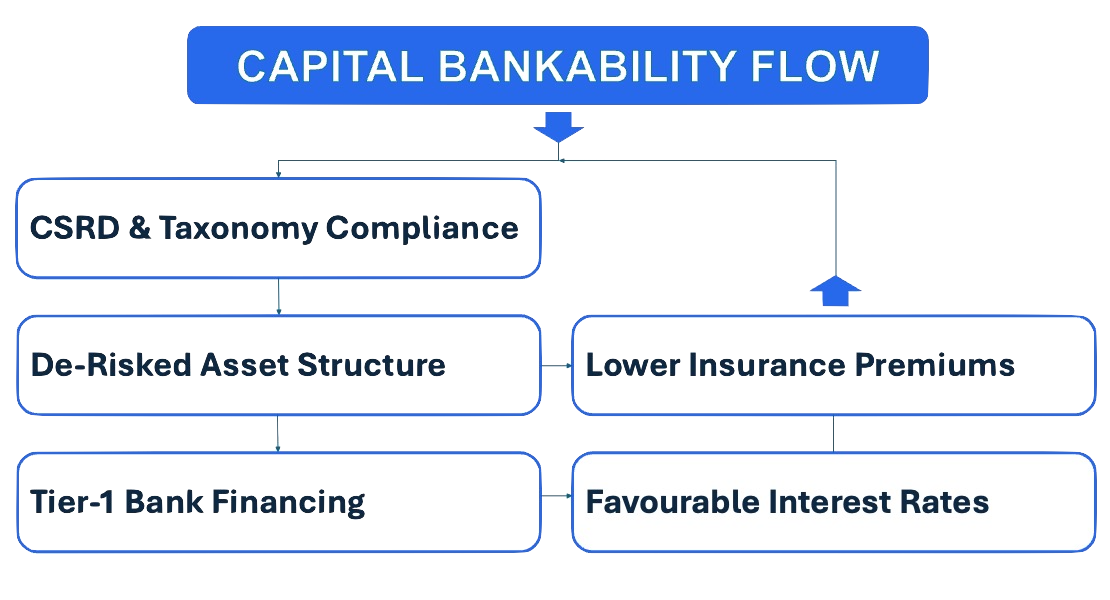
MDA CAPITAL INVEST, a.s. (MDACI) de-risks capital allocation and enhances project bankability by integrating the EU Corporate Sustainability Reporting Directive (CSRD) framework directly into our project lifecycles. For institutional investors, commercial banks, and Export Credit Agencies (ECAs), this policy guarantees that this project meets the stringent regulatory criteria required for European green finance, cross-border capital deployment, and institutional underwriting.
2. Double Materiality: Risk & Impact Governance
This project is managed under a strict dual-perspective risk matrix to protect investor capital while proving measurable real-world outcomes:
Financial Materiality (Outside-In). We identify, quantify, and mitigate physical climate risks, supply chain bottlenecks, and evolving carbon-border regulations (CBAM) before they impact project cash flows or IRR.
Impact Materiality (Inside-Out). We actively measure and minimize the environmental and social footprint of our construction, manufacturing, and distribution activities to prevent legal, operational, and reputational risks
3. Core ESG Pillars for Project Execution
Environmental Stewardship (ESRS E1/E5)
-
-
- Decarbonization & Scope 3 Clarity. Full transparency and tracking of Scope 1, 2, and 3 emissions across the entire project lifecycle. This data feeds directly into investor GHG accounting systems.
- EU Taxonomy & Green Loan Alignment. Project KPIs are structurally engineered to match the technical screening criteria of the EU Taxonomy for Sustainable Activities, qualifying the asset for specialized green bonds and sustainable credit facilities.
- Circular Resource Sourcing. We mandate that EPCIM contractors and industrial manufacturers implement waste-heat recovery, scrap-metal recycling, and closed-loop material cycles to optimize raw material costs.
-
Social Performance and Labour Guardrails (ESRS S1/S4)
-
-
- HSE Excellence on Site. Strict Health, Safety, and Environment (HSE) protocols are contractually enforced across all manufacturing centres, transport networks, and EPCIM construction zones.
- Value Chain Integrity. Zero-tolerance enforcement against forced labour, child labour, and human rights violations across all industrial component distributors and raw material suppliers.
- Community Alignment. Active local engagement and rapid-response grievance mechanisms to eliminate project delays caused by social friction or regulatory pushback.
-
Ethics, Governance and Financial Crime Defences (ESRS G1)
-
-
- Institutional-Grade Compliance. Bulletproof anti-money laundering (AML), anti-bribery, and anti-corruption (ABC) screening frameworks integrated into all project Special Purpose Vehicles (SPVs).
- Fiduciary Transparency. Comprehensive, independent third-party audits of both financial performance and ESG metrics to ensure data reliability for international investors and commercial lenders.
-
4. Underwriting and Reporting Readouts
-
-
- To ensure friction-free cross-border financing, all project-specific ESG data is structured for immediate digital integration:
- Prepared in machine-readable iXBRL / XHTML formats matching European Sustainability Reporting Standards (ESRS).
- Pre-mapped to satisfy the environmental and social screening mandates of Export Credit Banks, ECAs, and investment committees.
-
II. SUSTAINABILITY, ESG & MULTILATERAL DE-RISKING FRAMEWORK
1. Institutional Bankability and Capital Mobilisation
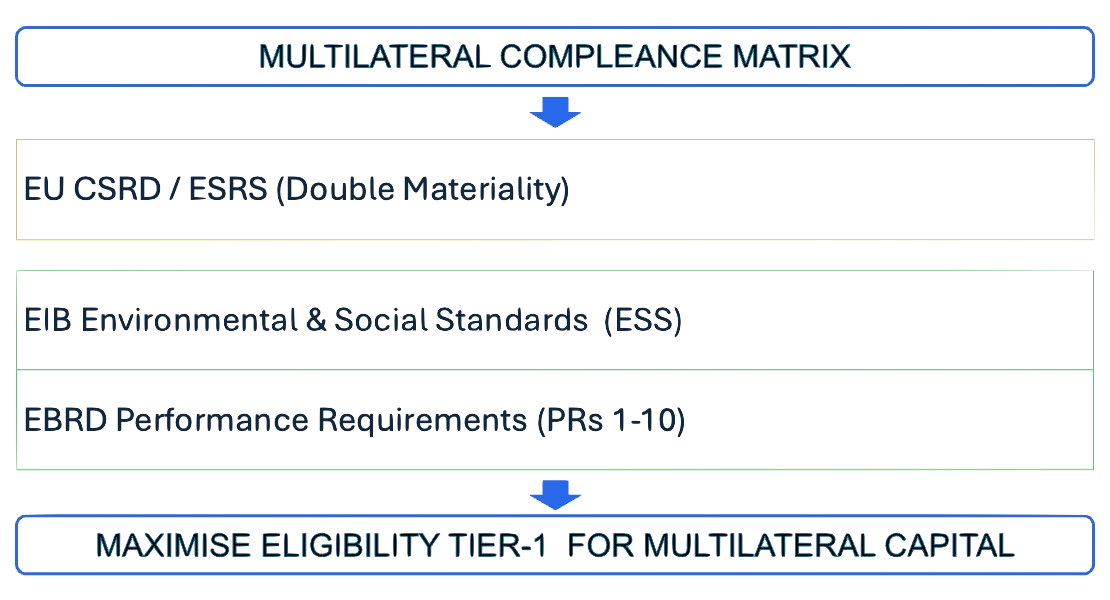
MDA CAPITAL INVEST, a.s. (MDACI) engineers its projects to meet the highest tier of international sustainability compliance, combining the regulatory mandates of the EU Corporate Sustainability Reporting Directive (CSRD) with the strict performance standards of global development finance institutions.
By structurally aligning our project lifecycles with the European Investment Bank (EIB) Climate Bank Roadmap and the European Bank for Reconstruction and Development (EBRD) Environmental and Social Policy, this project is optimized for direct equity investment, co-financing, senior debt underwriting, and credit enhancement from multilateral development banks (MDBs).
2. Integrated Compliance Architecture
Rather than managing multiple disjointed frameworks, MDACI operates under a single, unified ESG ledger that maps project data simultaneously across three critical regulatory pillars:
Sustainable Investment Pillar
|
EU CSRD/ESRS Mapping
|
EIB Standard Alignment
|
EBRD Performance Requirement
|
| Climate & Decarbonisation |
ESRS E1 (Climate Change) |
Standard 1: Climate Change |
PR 3: Resource Efficiency & Climate |
| Labour & Safety on Site | ESRS S1 / S2 (Workers) |
Standard 8: Labour Standards |
PR 2: Labour & Working Conditions |
| Supply Chain & Sourcing | ESRS E5 / S2 (Value Chain) | Standard 4: Resource Efficiency | PR 6: Biodiversity / Supply Chain |
| Community & Human Rights | ESRS S3 (Communities) | Standard 7: Rights / Interests | PR 5 / PR 7: Land / Indigenous Peoples |
| Financial Crime & Ethics | ESRS G1 (Business Conduct) | EIB Anti-Fraud Policy | EBRD Enforcement Procedures |
3. Multilateral Project Delivery Framework
Environmental De-Risking & The Paris Alignment
-
-
- EIB climate bank roadmap integration. The project undergoes a rigorous economic appraisal incorporating shadow carbon pricing to verify its economic viability under global decarbonization trajectories. It strictly avoids any activities excluded by the EIB's energy lending policy.
- EBRD transition impact and PR 3. We quantify the project's specific "Transition Impact," demonstrating how the deployment of advanced manufacturing, efficient distribution, or EPCIM technology permanently moves the host market toward low-carbon and circular business models.
- Do No Significant Harm (DNSH). Every phase of project design is screened against the EU Taxonomy's DNSH criteria, ensuring that climate mitigation efforts do not compromise water management, biodiversity, or circular economy thresholds.
-
Social Safeguards, Resettlement and Human Capital
-
-
- Comprehensive ESIA and ESMS. Before capital deployment, we implement a project-level Environmental and Social Management System (ESMS) matching EBRD PR 1. This encapsulates continuous environmental and social impact assessments (ESIAs) updated throughout construction and operation.
- Contractor HSE and forced labor eradication (EBRD PR 2 / EIB Standard 8). All EPCIM contractors and industrial product manufacturers are contractually bound to continuous, independent third-party labor audits. This ensures strict adherence to International Labour Organization (ILO) Core Conventions, eliminating modern slavery and supply chain exploitation.
- Stakeholder engagement and grievance (PR 10 / Standard 2). A transparent, culturally appropriate, and permanent Project Grievance Mechanism is deployed at all physical operational hubs to address community, worker, and buyer feedback without legal friction.
-
Institutional governance, anti-corruption and procurement
-
-
- Prohibited Practices Defences. We implement institutional-grade compliance architecture that satisfies the anti-corruption, anti-fraud, and anti-money laundering (AML/CFT) policies of both the EIB and EBRD.
- Fiduciary and procurement alignment. Where multilateral funding is directly utilized, project procurement strategies are optimized to comply with MDB open-tendering principles, ensuring transparency, fair competition, and cost-efficiency for investors.
-
4. Investor Readout and Technical Verification
-
-
- To facilitate immediate due diligence by investment committees, project data room materials include:
- Pre-formatted Environmental and Social Action Plans (ESAP) ready for MDB incorporation into credit agreements.
- iXBRL-tagged sustainability reporting that flows seamlessly into commercial bank portfolios, commercial insurance models, and institutional ESG aggregators.
-
III. SUSTAINABILITY, MULTILATERAL DE-RISKING AND EU GLOBAL GATEWAY STRATEGY
1. Executive Summary - Mobilising Euro-African Capital Networks
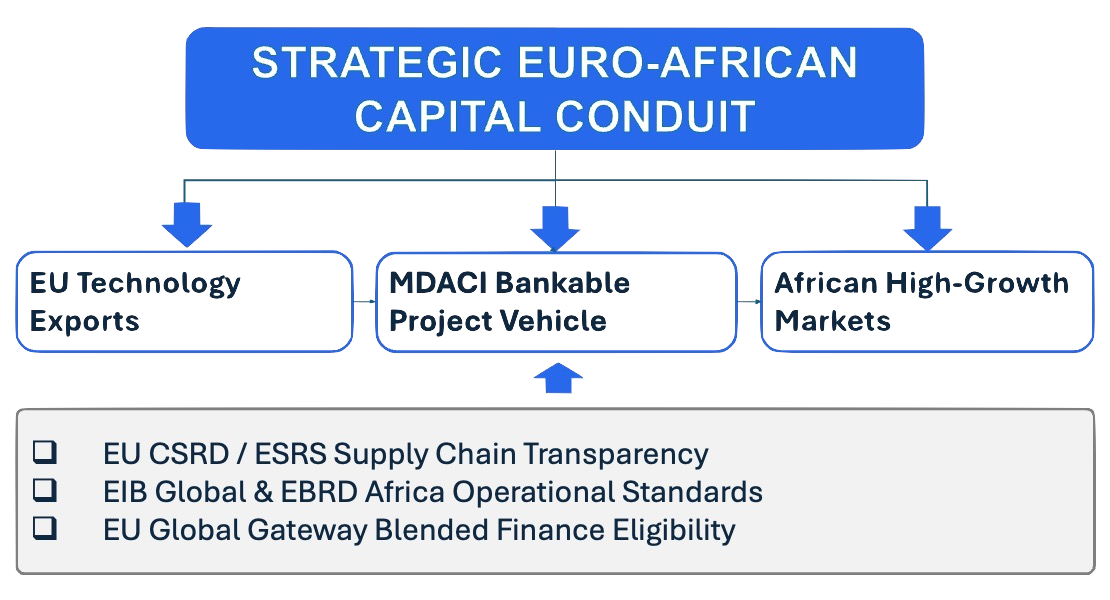
MDA CAPITAL INVEST, a.s. (MDACI) strategically engineers this project vehicle to serve as a high-yield, fully de-risked conduit for the deployment of advanced European industrial technologies into high-growth African markets (including Senegal, Côte d'Ivoire, Kenya, Nigeria, Ghana, and South Africa).
By structurally bridging the regulatory mandates of the EU Corporate Sustainability Reporting Directive (CSRD) with the strict developmental and environmental criteria of the European Investment Bank (EIB), the European Bank for Reconstruction and Development (EBRD), and regional development institutions, this project functions as a cornerstone asset under the EU Global Gateway Strategy. This dual-compliance architecture maximizes project bankability, secures sovereign/sub-sovereign underwriting, and opens access to specialized Euro-African blended finance facilities.
2. Strategic Alignment with EU External & Export Policies
This project goes beyond traditional development finance by actively advancing the EU's geopolitical and industrial competitiveness while ensuring complete compliance across both European and African legal jurisdictions:
-
-
- The EU Global Gateway Initiative. Project structures are designed to qualify for the EU's €300 billion infrastructure fund, supporting sustainable, high-standard connections that prioritize green, digital, and resilient supply chains.
- Boosting EU Export Competitiveness. By utilizing EPCIM contracts that mandate high-value European technology, machinery, and software components, we optimize the project for maximum coverage from European Export Credit Agencies (ECAs) and Export Credit Banks.
- CBAM & Carbon Border Preparedness. For industrial products manufactured or processed in the African host nations for export back to the EU, our strict ESG data tracking prepares the asset for the Carbon Border Adjustment Mechanism (CBAM), ensuring future tariff resilience.
-
3. Multilateral Compliance Framework for African Deployments
Environmental Sustainability and Local Climate Resilience (EIB Global / EBRD)
-
-
- EIB global operational standards. Because operations sit outside the EU, the project adheres to the EIB Global framework, emphasizing sustainable job creation, climate adaptation, and cross-border trade facilitation.
- Paris alignment and transition impact in Sub-Saharan Africa. We deploy modern European technologies to drastically lower the emissions intensity of the host country's industrial baseline, fulfilling EBRD PR 3 and satisfying the EIB's strict energy and infrastructure lending exclusions.
- Environmental Impact Assessments (ESIA). Comprehensive baseline studies are established to protect local African biodiversity, combat water scarcity, and guarantee the Do No Significant Harm (DNSH) criteria required by European institutional funds.
-
Social Safeguards, Local Content and Human Rights (EBRD PRs & EIB ESS)
-
-
- EBRD performance requirement 5 and 7 integration. Project site acquisition explicitly follows international standard safeguards regarding land acquisition, involuntary resettlement, and economic displacement. It protects indigenous peoples and vulnerable community groups across all project footprint areas.
- Local content optimisation and skill transfer. We pair advanced EU technology with structured, funded local technical training programs. This satisfies host-country local content regulations, builds long-term community goodwill, and fulfills EBRD PR 2 (Labor and Working Conditions).
- Supply chain audits and human rights (ESRS S2). Rigorous, independent third-party monitoring is contractually mandated across all regional distributors, logistics hubs, and construction zones to ensure complete eradication of modern slavery, child labor, and gender-based discrimination in accordance with ILO Core Conventions.
-
Fiduciary governance and anti-financial crime defenses (ESRS G1)
-
-
- Cross-border financial integrity. To address regional risk indices, MDACI deploys a bulletproof anti-money laundering (AML/CFT), anti-bribery, and anti-corruption (ABC) framework. This matches the strict compliance thresholds of commercial investment banks and MDB peer reviewers.
- Compliant procurement tracking. Procurement pathways strictly follow transparent, competitive open-tendering frameworks accepted by international financiers, guaranteeing zero leakages of investor or development bank capital.
-
4. Digital transparency and investor assurance
To facilitate frictionless cross-border capital deployment, the data room for this project incorporates:
-
-
- A ready-to-execute Environmental and Social Action Plan (ESAP) pre-mapped to EBRD Performance Requirements (1-10) and EIB Environmental and Social Standards (1-11).
- Continuous iXBRL-tagged sustainability reporting that aggregates upstream African operational data into a format directly ingestible into European corporate CSRD dashboards.
-