
QuestPID
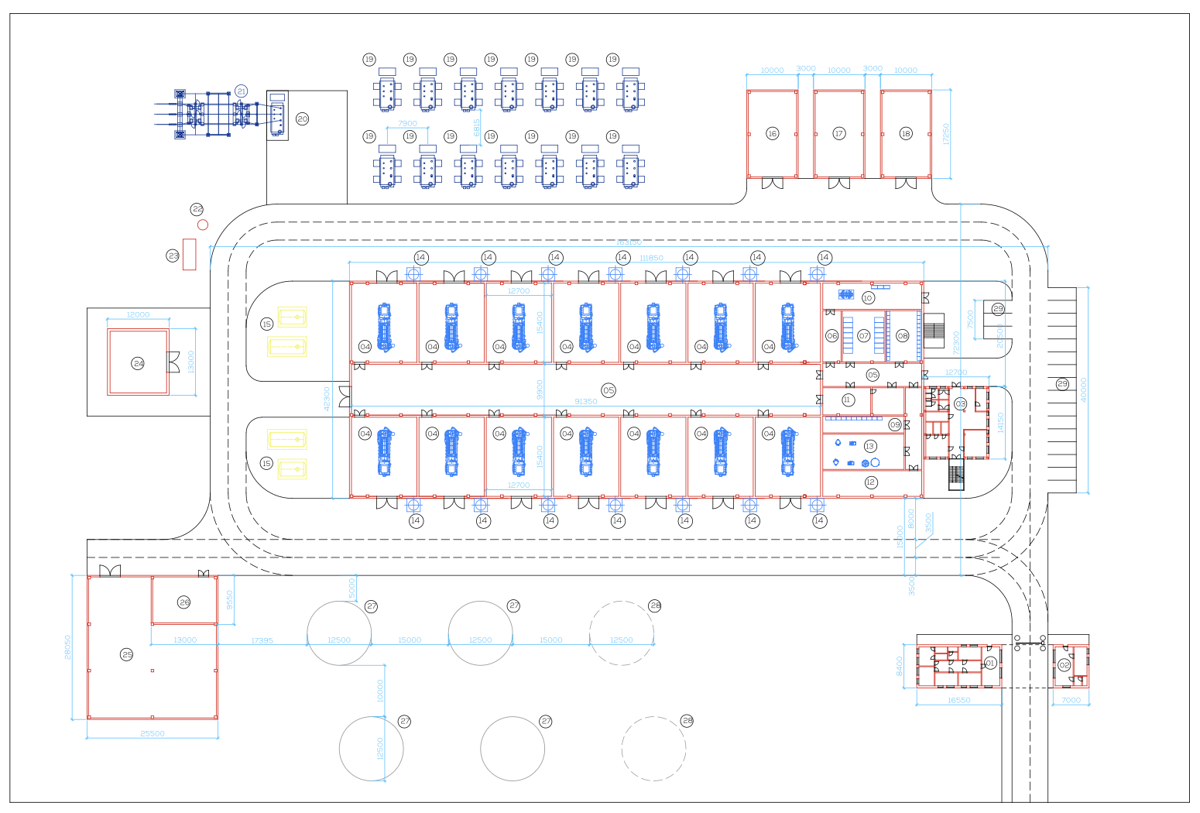
The Ethanol Plant's automatic backup Biogas Power Generation (BPP) consists of 14 x 1MWh installed Biogas Genset units from MMW Czech. The Genset are designed and installed to operate independently for each secteur of the Ethanol Plant to maximize availability and efficiency 24/7, and minimize operation expenses. Besides, each independent unit shall not require any licensing due their small installation capacity which does exceed 1 MW. As automatic backup power supply units to backup the power supply from the national grid, their primary function is to secure the uninterrupted power supply to the Ethanol Plant facilities.

Why Biogas Power Plant?
For the purpose of bankability, the CassavaTech's High Quality Ethanol Production Plant shall be provided with its own integrated backup power generation plant, securing its uninterrupted operation 24/7. Hence, the Ethanol Production Plant can be powered with Biogas Power Plant (BPP) or a Hydroelectric Power Plant.(HPP). Our studies have demonstrated that BPP is highly more bankable and more technoeconomically feasible than HPP. Besides, the BPP and more ecologically and environmentally friendly that HPP due added value to protection and development of the ecosystem, transforming wastes to energy and using residues as biosolids fertiliser for the Cassava Farm.
BPP Main Specifications
Code |
Systems |
Paratmer / Name |
Value |
| CASTEC-002-BIOGPP-01 | Biogas Power Plant | Power Plant Total Installed Capacity | 14 MW |
| CASTEC-002-BIOGPP-02 | Engine | Engine TCG 2020 V12 | 1.2 MWh (1,200kW) |
| CASTEC-002-BIOGPP-03 | Fuel System | Fuel Consumption (Biogas) | 2,489 kW (+5%) |
| CASTEC-002-BIOGPP-05 | Generator | Generator Efficiency | 97% |
| CASTEC-002-BIOGPP-06 | Cooling Tower |
Cooling Water Consumption |
139 dm³ (litres) / engine |
Basic Development Data Processing
This MDA's AI Question and Answer (Q&A) systems project, called QuestPID, is designed under an "ask me" or "ask AI" paradigm, use Natural Language Processing (NLP) and Retrieval-Augmented Generation (RAG) to understand, process, and answer queries across various fields and business industries related to every aspect of human's daily life. The project is more than just a simple keyword searching. Compared chatGPT, Open AI, and all other similar projects, DeePQA is based on academically developed database, certified knwoledge and expert judgement, going beyond understanding context to provide precise answers, summarise documents, and even act as a "digital co-pilot" across different fields as specified below.
QuestPID's Business Industries
1. Healthcare & Biomedical
-
- Clinical support. AI answers queries about symptoms, rare diseases, and treatment options, aiding clinicians in diagnostic decision-making.
- Patient interaction. Virtual assistants and chatbots provide patients with evidence-based health information, answer medication-related questions, and conduct preliminary symptom assessments.
- Document analysis. AI quickly parses massive medical records and research papers to provide accurate answers to specific questions about patient history or treatment protocols.
2. Finance & Banking
-
- Customer support & sales. AI assistants answer customer inquiries about account balances, transactions, and product details, reducing support volume.
- Risk analysis & compliance. AI analyses vast amounts of regulatory documentation and financial reports to answer questions about compliance requirements and risk assessments.
- Personal finance. Robo-advisors answer investment-related queries and provide personalized portfolio guidance
3. Education & Training
-
- Personalized tutoring. AI chatbots provide 24/7 support to students, answering questions across multiple subjects based on internal knowledge bases.
- Adaptive learning. Systems identify knowledge gaps by asking students diagnostic questions and adapting learning materials to their level.
- Content generation. Educators and Trainers use AI to generate quizzes and study materials on specific topics.
4. Enterprise & Corporate Knowledge
-
- Internal Support. AI acts as an HR or IT assistant, answering employee queries about policies, benefits, or technical issues instantly, reducing the need for manual searching.
- Document Search. Employees can ask questions to find information buried in long manuals, legal documents, or project reports.
5. Technical & Support (IT/Dev)
-
- Debugging Assistance. Developers provide code snippets and error messages to AI to receive explanations of bugs and potential fixes.
- Documentation Search. Technical support tools parse documentation to answer complex queries about product APIs or configurations.
6. Customer Service (E-commerce)
-
- Immediate Support. AI handles inquiries about order status, return policies, and product specifications.
- Product Recommendations. AI answers questions to help users choose products based on their needs.
Key QuestPID's "Ask Me" Strategies for Better Results
-
- Probing for Gaps. Asking AI to ask you questions to assess your knowledge or identify gaps in your reasoning before providing an answer.
- Contextualizing. Providing specific context (e.g., "Act as a financial analyst...") helps the AI tailor its answers.
- Iterative Questioning. Asking follow-up questions until a topic is fully understood.
Why PID or P-I-D
PID (Persistent Identifier) is herein defined as a long-lasting, unique reference to a digital resource (such as a document, dataset, person, or organization) that ensures it can be found, identified and accessed reliably over time, even if its location or URL changes.
Therefore, in the context of finding the "right and exact answer to a quest," a PID acts as an unambiguous label, connecting searchers to the precise answer (not just a similar one) to their quest or question, thereby eliminating confusion, preventing "link rot" (broken links), and solving the problem of name ambiguity, using only the accurate MDA Big Data developed by MDA Global Accademy members and collaborators (Scientists, and certified Researchers, Professionals and Epxerts).
Key components for "Right & Exact" answers
- Unique and Unambiguous. Unlike names or titles which can be shared, a PID is a unique string of characters assigned to one, and only one, entity.
- Permanent (Persistent). PIDs are maintained by service providers to ensure the link remains valid forever, bypassing the failure of standard URLs.
- Actionable. A PID is usually a clickable hyperlink that resolves to the current location of the digital resource, or to a landing page with metadata about that resource.
- FAIR Data Principles. PIDs are essential for making data findable, accessible, interoperable and reusable.
Common examples (Research & Information)
- DOI (Digital Object Identifier). Frequently used for academic publications, journal articles, and datasets (e.g., 10.1000/182).
- ORCID (Open Researcher and Contributor ID). Identifies specific individuals to prevent confusion between authors with the same or similar names.
- ROR (Research Organization Registry). Uniquely identifies research institutions and organizations.
- ISBN (International Standard Book Number). Identifies specific editions of books.
- Handle. A versatile, underlying system used for digital objects in archives and libraries.
Why PIDs Guarantee the "Exact" Answer
If a query aims to find "the specific dataset used in the 2020 CERN report," a regular search might return broken links or various versions of similar data. A PID (like a DOI) for that specific dataset will always point to that exact, unchanging dataset, regardless of whether the publisher changed its website structure. So, whatever it is, the primary purpose of the PID is to provide the information required to reliably identify, verify and locate it. A PID may be connected to a set of metadata describing an item rather than to the item itself.
Biogas Power Plant Layout
Power Plant Designs Gallery