

COMPANY GHG EMISSIONS ASSESSMENT REPORT
REPORTING ENTITY
MDA CAPITAL INVEST (MDACI)
REPORT TYPE
Corporate Portfolio GHG Emissions Framework
CONSOLIDATION APPROACH
Operational Control for Operations; Partnership/Financed Approach for Projects
KEY PARTNERS/FUNDING ECOSYSTEM
EPCIM Partners,
Cooperating Financiers (EU Export Banks, Export Guarantee Corporations, Commercial/Investment Banks), and
Private Investors (Angel Investors, Venture Capital, Equity Investors.
IMPLEMENTATION VEHICLE
EPCIM Partners (Engineering, Procurement, Construction, Installation, Commissioning)
SCOPE 3 CATEGORY
Category 15 (Financed and Equity-Invested Emissions)
1. Executive Summary
MDA CAPITAL INVEST (MDACI) generates near-zero direct operational Greenhouse Gas (GHG) emissions (Scope 1 and 2), while its Scope 3 financed emissions across its 21 targeted business sectors (including Aerospace & Defence, Agriculture & Farming, Automotive & transport, Banking & finance, Energy & Utilities, Engineering & Technology, Industrial Manufactring, Life Sciences, Mining, Power & Utilities, and Water & Sanitation industries) vary based on project deployment by its Engineering, Procurement, Construction, Installation and Management (EPCIM) Partners.
MDA CAPITAL INVEST acts as a project developer and funding arranger rather than a direct asset owner. Consequently, its Scope 1 (Direct) and Scope 2 (Indirect) emissions are near-zero as stated above. They are restricted to corporate office spaces, utility usage, and business travel.
The primary carbon footprint of MDACI is embedded within Scope 3 (Category 15, cosnsiting of Financed Emissions). These emissions stem from project development, engineering, procurement, construction, installation, and commissioning (EPCIM) phases. The total footprint depends entirely on the sector mix and capital expenditure (CapEx) allocated to individual projects undertaken by MDACI and its Partners in each business industry or sector.
2. Operational Footprint (Scope 1 & 2)
-
-
- Scope 1 (Direct). Negligible, limited to minor direct fuel consumption or fugitive emissions from corporate office facilities.
- Scope 2 (Energy Indirect). Minimal, accounted for via purchased electricity and office heating across corporate workspaces.
-
Emission Scope |
Source Categories
|
Baseline Carbon Intensity |
Mitigation Strategy |
| Scope 1 (Direct) | Corporate vehicles, office refrigerants |
Negligible (<5(tCO2e) |
Transition to electric fleet options |
| Scope 2 (Indirect) | Purchased grid electricity, heating/cooling |
Low (<25(tCO2e) | Procurement of renewable energy credits (RECs) |
3. Financed Emissions Overview (Scope 3, Category 15)
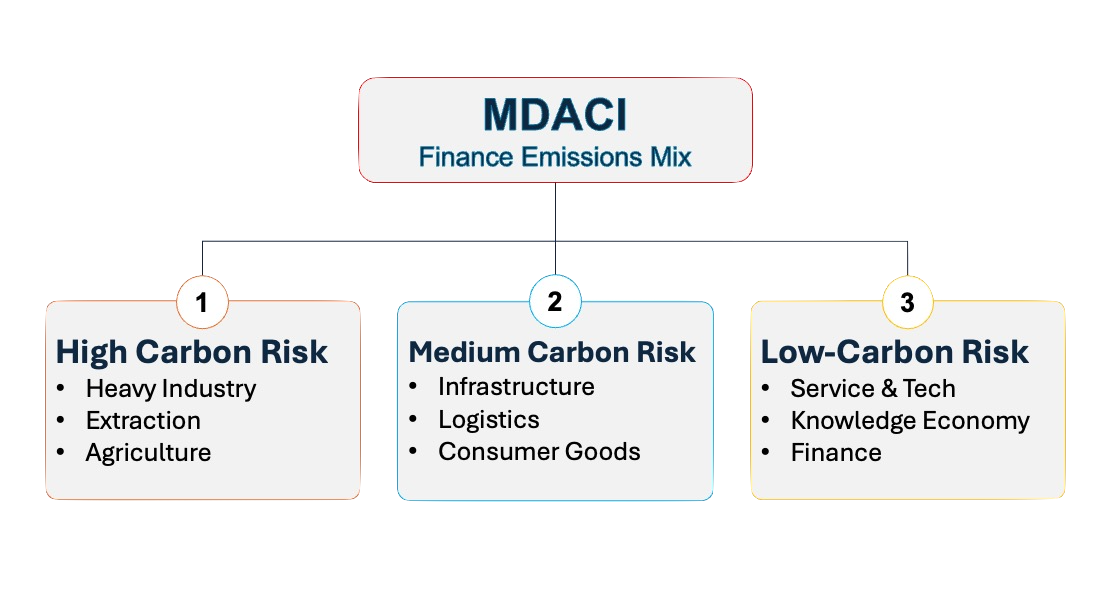
The industries listed by MDACI are categorized into three main Risk Profiles based on standard global greenhouse gas accounting metrics.
3.1 High Carbon Risk Sectors
These sectors feature direct processing emissions, high energy demands, or heavy land-use changes.
-
-
- Agriculture & Farming. Significant methane (CH4) and nitrous oxide (N2O) footprints from livestock and soil management.
- Energy & Utilities / Power & Utilities. Heavily dependent on the grid mix; high impact if fossil-fuel powered.
- Industrial Manufacturing / Mining, Metals & Minerals. Highly carbon-intensive due to thermal processing, extraction equipment, and raw material transformation.
- Natural Resources. Associated with extraction operations and upstream land disturbance.
-
3.2 Medium Carbon Risk Sectors
These sectors are characterized by significant transport, logistical, or complex assembly supply chains.
-
-
- Aerospace & Defence / Automotive & Transport. Driven by supply chain logistics, manufacturing, and product life-cycle usage.
- Logistics & Supply Chain / Packaging. High diesel consumption footprints from freight transport and distribution operations.
- Chemicals & Materials (Pharmaceuticals / Cosmetics / Fashion & Apparel). Embodied carbon in raw inputs and processing energy.
- Food & Beverages / Consumer Goods / Retail & Wholesale. High refrigeration (HFCs), packaging, and distribution footprints.
- Real Estate / Infrastructure. Driven by embodied carbon in construction materials (cement, steel) handled by EPCIM partners.
-
3.3. Low Carbon Risk Sectors
These sectors feature low energy footprints, primary reliance on grid electricity, and knowledge-based activities.
-
-
- Banking & Finance / Insurance. Primarily paper, office electricity, and digital transaction processing.
- Education & Training / Art & Craft. Low material intensity; footprints are tied to facility lighting and climate control.
- Electronics & Semiconductors / High-Tech / Telecom & ICT. Highly energy-efficient operations, though semiconductor fabrication carries localized fluorinated gas risks.
- Software & Hardware / Engineering & Technology. Driven by data center power consumption and corporate office footprints.
- Health & Beauty / Life Sciences. Primarily restricted to R&D labs and clinical administrative facilities.
- Environment & Ecology / Water & Sanitation. Focuses heavily on climate-positive impacts, though water treatment demands baseline process energy.
-
4. EPCIM Climate Risk and Financing Alignment
To maintain compliance with EU Export Banks and international financiers, MDACI applies a strict carbon screening protocol to all bankable projects before arranging funding:
- Financier Compliance. Projects must align with the Equator Principles, EU Taxonomy criteria, and Export Guarantee Corporation sustainability standards.
- EPCIM Procurement Audits. EPCIM partners are required to prioritize low-carbon raw materials, optimize transport logistics, and implement energy-efficient construction processes.
- Decarbonization Goals. Green technologies, carbon capture, and resource efficiency loops must be integrated directly into the project design phase to improve financing terms.
5. Financing and Investment Structure
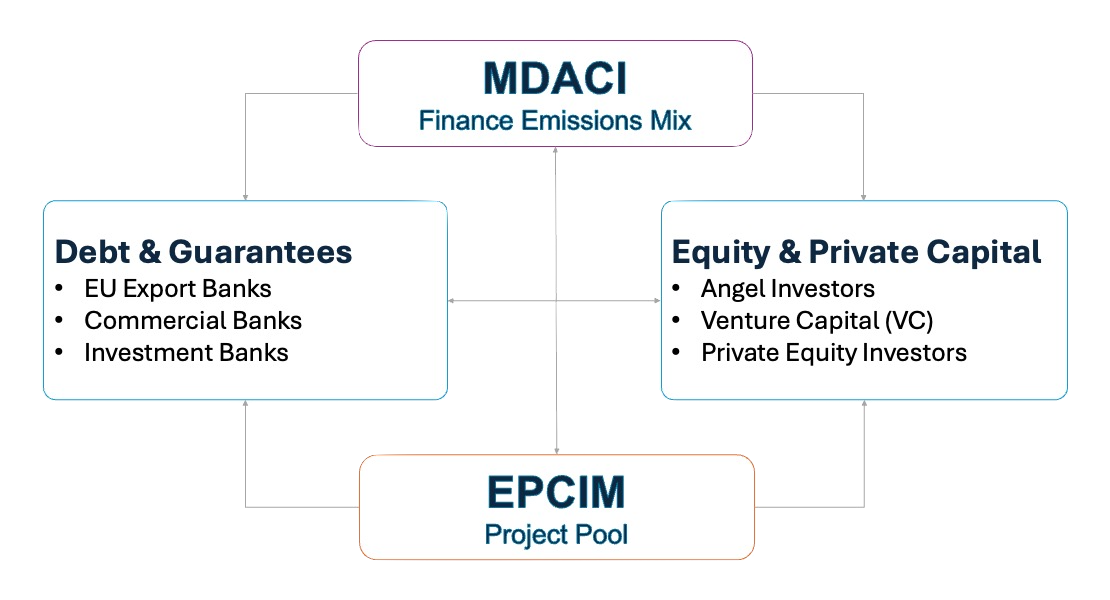
The integration of private equity, venture capital (VC), and angel investors expands MDACI's Scope 3 accounting. Under the GHG Protocol Corporate Value Chain (Scope 3) Standard, equity investments require proportional carbon accounting based on MDACI's ownership share or investment leverage.
6. Impact of Private Investors on GHG Risk Profiles
Private capital injections alter how emissions are tracked, managed, and mitigated across the project life cycle:
6.1 Angel and Venture Capital (Early Stage)
-
-
- Sector Focus. Frequently directed toward High-Tech, Software & Hardware, Telecom & ICT, Life Sciences, and Environment & Ecology.
- GHG Dynamics. Low initial operational footprint, but critical for funding early-stage decarbonization technologies or software-driven supply chain efficiencies.
- Tracking Method. Forward-looking lifecycle assessments (LCA) to ensure scalable green technologies do not create carbon lock-in.
-
6.2 Private Equity and Institutional Investors (Growth/Late Stage)
-
-
- Sector Focus. Heavy infrastructure, Real Estate, Industrial Manufacturing, and Power & Utilities.
- GHG Dynamics. High capital allocation directly correlates with large-scale material procurement and construction emissions handled by EPCIM partners.
- Tracking Method. Proportional equity-share accounting, where MDACI and its equity partners absorb a direct percentage of the project's total asset footprint.
-
7. Integrated Investment and EPCIM Carbon Safeguards
To balance the risk tolerances of private investors with the strict sustainability mandates of EU Export Banks, MDACI applies a unified carbon vetting process:
-
-
- Dual-Gate Screening. Projects must simultaneously clear institutional green mandates (e.g., EU Taxonomy) and private investor ESG (Environmental, Social, and Governance) risk matrices.
- Proportional Asset Accounting. For equity-backed ventures, carbon data is calculated based on the percentage of equity held, creating transparent carbon liability ledgers for angel and VC participants.
- Decarbonized EPCIM Delivery. EPCIM partners must provide verified Environmental Product Declarations (EPDs) for construction materials to protect private equity from future carbon taxes or stranded asset risks.
-